15.5.10

TACTILITY.

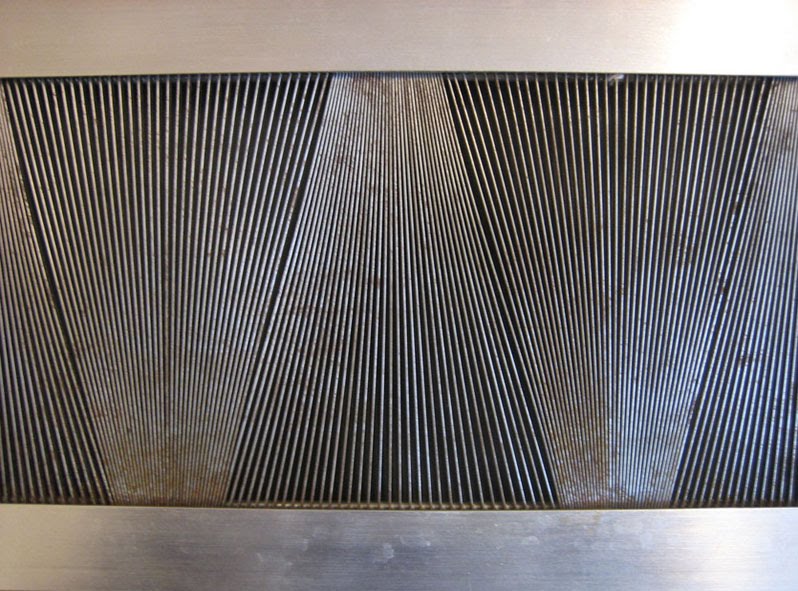
Surfaces that contains different kinds of tactility, have always inspired me when weaving.

In Peru, me and my husband visited several places and especially Urubamba with it's salt minerals impressed me. When coming there and seeing the complete view, it was amazing.

I like taking close-up of pictures, so I get the complete surface, structure, tactility and 3-dimensional effect. I use this in the beginning part of my weaving.

Two views.
Close-up.
At this very thin part where the white is, people were walking, when going to one place and another. I never found out how deep they were.
Top of the surface is a little bit crackled.
I love the crispness that is shown in this picture. Almost like frozen water.
On the sand where we were walking, there were a very thin layer of salt and all of it were crackled into a beautiful pattern.
Another frozen part, almost like snow.
I think it was amazing to see so many structures, and the whole experience is still inside of me. Going to Urubamba, seeing the salt minerals is recomendable. Next time me and my husband is in Peru, I will visit again.

9.5.10

MOJIRI-ORI IN JAPAN.

Last year I travel to Japan to study the weaving technique GAUZE, in Japan called Karami-oro or Mojiri-Ori. I call it Mojiri-ori as I have learned from Living National Treasure Takeshi Kitamura.
Mojiri-Ori was imported to Japan in the 7th and 8th century. Mojiri means movement and Ori to weave.
When I learned how to weave many years ago, I was told there were three main structures or techniques. 1: plain, 2: twill and 3: satin. In Japan there is a 4th which is Mojiri-Ori. There is three types of Mojiri-Ori: Sha, Ro and Ra.
Sha is the most simpel Mojiri-Ori. It consist of the standing- and the twisting thread. This is the one I call the plain gauze.
Ro consist of Sha and plain weave.
My own weavings is a combination of Sha and Ro together.
Ra is the complex gauze. This is the ground idea. The ground idea is often used in the peruvian gauze. It is possible to make very complex patterns by using the Ra.
I was living 1½ hour from Kyoto city in Keihoku. A little villages surrounded by mountains. In this little agriculture community there are many weaving companies and also some of the biggest artists have there studios here.
Toshio Tada, a specialist in Mojiri-Ori have been working most of his life in factories in the Nishijin area in Kyoto. He was my teacher for two weeks in Keihoku.
The above picture shows shifu paper, which is plated with gold in patterns and then cut into very thin strips, so it is possible to weave with.
A work by Toshio Tada, an obi in Ro-kin. Woven in silk and shifu paper plated with gold on a jacquard loom.
Detail.
Toshio Tada had many special working methods.
Here is an obi, about 35cm in width, consisting of 2400 threads. He wanted to tighten and make the warp even. Where most weavers would have used a spray can, he drank some water and blew it over the warp.
Very sweet.


Toshio Tada and I at his home. He invited me to his place to show me a special book about Mojiri-Ori at the Shosoin Treasures in Nara.
I went to Kawashima Textile School where I was able to be part of a special tour to the company connected to the school.
Here two men was able to weave Mojiri-Ori and they showed me some of the work made at the company.
The top picture and the one below is an obi woven in a very thin silk. The pattern looks very chinese inspired.
I like to take pictures through a magnifying glass, so I can get some good details. Then it is also possible for me to analyse the technique better when I am back home.
Another textile in silk.
This obi was woven in a silk that had a special rubber or plastic feel. Perhaps it was woven in kasuri as the color faided beautiful into each other.

25.4.10

TEXTILES SAMPLES AT MY STUDIO.

Today Sunday I am sitting at my studio working on a project at my loom.

I have been looking through a samplebook I start making many years ago, when I was working in Italy. I got the oppertunity to work in Como and Prato.
This sample is my favorite of all I have. It is woven in silk on a jacquard loom.
Sometimes I use the textile samples for inspiration or just as today to look at, as they are so beautiful.
Some of the pattern (the thick threads) are made in deflected weave technique.
I like the combination of thick and thin and how simple a pattern can be made when working with this.

Two samples in black / white. The first in very thin cotton, complex and woven on a jacquard loom. The other in thick wool. Both are interesting and could be used for interior as curtain and blankets.


The last three I have chosen to show is ideal for upholstery.
I like to look through my samplebooks, both with my own woven textiles and here old ones, as there are a richness of surfaces, structures and tactility.

12.4.10

WEAVING WITH THE FAN REED.

In 1998 when I did an exchange to the Philadelphia College of Textiles & Science, I came across these beautiful samples at a little museum, which were connected to the college.
The samples are all woven with a fan reed, some also call it ondulé. In Japan this kind of reed is called YOROKE. There are different kinds of ideas behind these two reeds, and therefore for me it is the fan reed I weave with.
I took these pictures, and as you can see there are diffenrent kinds of possibilities depending on how you set up the threads on the loom.
It was first many years later I start weaving with the fan reed, after my graduation from the Danish School of Design in 2000.
I have three fan reeds with different settings and is therefore able to use diffenrent kinds of thick and thin yarns for the warp material.
My first fan reed I got it from an old man, whose wife had past away. Here I am able to use very fine and thin yarns. In the middle of the reed the setting are 70/10. This means there are 70 holes per each 10 cm.
Another reed where the setting are 30/10.
And finally the last one which I have had made specially for me. My idea was to make a mix of the 70/10 and 30/10 in the same reed. When taking contact to the place in Sweden where I have had the 30/10 made, they told me it was impossible to make the reed as I wanted. Fortunately I found another place who could make the reed and because this one is much more difficult to make the price became much higher.
When working with the fan reed, this can be woven on an ordinary contramarch loom. I have put this extra equipment on my loom. This means I can change the positions of where the warp threads are in the reed. It is also possible to make the changement of the warp threads if you have a loom with a lot of holes in the beater. Both of these two takes time to weave, but the result you get is stunning and is worth the effort you put in to the work.
The threads are in the lower part of the reed when you beat the weft threads together.
And here in the top part of the reed.
A close-up of my first room divider I wove with the fan reed. The material are polyester and monofilament. The technique is gauze.
Another friend of mine Anne Selim weave beautiful scarfs with the fan reed.

21.3.10

DETENTES FROM PERU.

In the area called Miraflores in Lima there is a lot of antique shops. Here I found all my detentes.

Detentes is a little piece of textile which is embroidered with often a heart. I was told by one owner of a shop that people goes to the monastery and asked the nuns to make them a detente. The detente is then hanged either in the church or on a Saint and the person prays for a miracle to happen. When the miracle has come true, it is okay to put away the detente. I did not see a lot of detentes in the churches. Instead I saw a lot of the silver hearts which is used for making an offering to show a persons gratitude.


Two small detentes, about 2x2 cm. The heart in both detentes is raised from the bottom of the fabric. The detente to the right have lost a lot of it's embroidery, but is still beautiful.
When my husband came from Peru to live with me here in Denmark he had the little detente with him to the left.


The two first detentes I bought. They are different from all the others as Maria and Jesu are the main persons hidden behind a piece of plastic to prevent them from getting dirty.
The details in the detentes are symbolic. The heart is shining. Inside the heart a crown is made out of thorns and therefore it is bleeding. Everything is related to Jesus crucifixion.
It says: DETENTE el Corazón de Jesús está conmigo: the heart of Jesus is with me.
When buying some of my detente I was told by one antique owner, when she went on a flight she always put a detente inside her jacket, for good luck.
Another very simpel detente showing the crown made out of thorns.
Out of all my detentes this one is my favorite. The bleeding heart is put onto a big cruciform and with a little criciform on the top. It has so many details and the embroidery is amazing. On the edges beads are sewn.

14.3.10

MY SASHIKO BAG FROM JAPAN.

I have just bought this wonderful and so beautiful SASHIKO bag.

SASHIKO is a quilting technique using a running stitch to reinforce and prolong the life of a fabric or to stitch and recycle old pieces of cloth into a new garment. SASHIKO created warmer and more durable fabrics for the Japanese farmer who originally used the stitch for practical reasons. Decorative SASHIKO stitching developed out of the need for warmth and durability and functions to embellish while strengthen the garment.

The bag is about 80-100 years old and has probably been used to collect money. The name of the pattern is "Asa no ha". Asa is hemp and ha is leaf.
This pattern is so beautiful and so well made. I find it interesting to see that the person who have made this bag, have made the little changement in the stitching of the pattern.Detail.
"Manji tunagi." The mean of manji is the ward of Buddhism and tunagi means connection.
Detail.
Everywhere I look there are a new SASHIKO stitch.
Detail.
The stitch of the bottom is a similar pattern that was found in the northern Japan, but it was made in the western area.
In another post Gallery Kei in Kyoto, I have recommended several books about SASHIKO.