6.1.11

PISQUILLO IN THE CHANCAY VALLEY.

Happy New Year to everyone.

I want to start the New Year by writing a post about what is close to my heart; the Gauzes from the Chancay Culture in Peru.
I have from an earlier post Chancay Gauzes from Museo Amano, Lima, Peru wrote about these amazing textiles.

When I went to Peru on my third trip I contacted Museo Amano. My dream was to visit the Chancay Valley. I wanted to feel the atmosphere and breathe in where these amazing textiles have been woven, for so many years ago.

Here I am on my way with Museo Amano to the Chancay Valley.
The whole area is an archeological place, a dessert.

I remember I was a bit disappointed when seeing it the first time, because we (Mr. Watanabe, his nephew and I) where the only people there. Also there were no fencing and it didn't seemed like it has been taking care of by the Peruvian Government. For me that was surprising and sad, as I think this is a very important culture in the Peruvian history.

Mr. Watanabe told me that to him and his family this was there second home. They went there often once a week.
In the sand bones, broken pottery and textiles where still lying, surprising to me. I think it's sad the Spanish came and broke all these beautiful things, as they were hoping to find gold inside the pottery.
Mr. Watanabe had a very good eye. He told me he had been there so many times and also he was there in the 1950-60 when he and Mr. Yoshitaro Amano (the founder of Museo Amano) were doing the first archeological excavations.
The textile Mr. Watanabe found. It's a very simple piece and here it's not easy to see, but above and below the pattern there are two rows of a very simple leno with plain weave in between.
Today this textiles is hanging in my livingroom. In a future post I will show some close-up of the textile.
Ruins in Pisquillo.
Everywhere in Peru where textiles have been made there is water, this is the lake of Chancay. So beautiful.
I think it's the first and unfortunately also the last time I will ever see this amazing place. Mr. Watanabe told me that in 5-10 years it will probably disappear, as all the other villages in the Chancay Valley.
I think it's so sad. Deep down inside of me I was waving sadly goodbuy to this, for me very important place in the history of Peru; Pisquillo in the Chancay Valley.

13.12.10

OUR CHRISTMAS TREE.

I can not stop posting pictures of our Christmas tree.
This year is special as it is the first time my husband and I are spending Christmas together at our little flat in Copenhagen.
This year I have bought an old Christmas tree stand.
Our Christmas tree is full of old glass decoration made in Germany and Czech republic.
I love angels of all kinds. Here you can see one from Peru to the right. This year I bought angels from a danish ceramist, who have made some in very thin porcelain.
On the picture here you can also see some handmade pom poms I have made. All of them made by yarns from the japanese yarn company Nakachuu. The pom pom to the left is made with reflex yarn.
The pom poms can be bought through my etsy page.
A little owl and Santa Claus on clips.
A duck in glass.
Czech republic decoration in glass.
One of the wise men on a clips. Beautiful and rare.
I wish everybody a beautiful and happy Christmas.

23.11.10

THREE YEARS WITH THE CHANCAY GAUZES.

Today (November the 24th) is a very special day to me.

Exactly three years ago I meet my husband in the center of Lima at Placa de Armas, Peru. I came to Lima three days earlier as I had an appointment with Museo Amano, to study there beautiful collection of Chancay Gauzes.

This post is a tribute to my husband and our marriage.
In January 2010 I wrote another post about my studies of the Chancay Gauzes. Please have a look for further information.

When studying the Gauzes I always started out by taking a photo with a ruler. This help me now when I am back in Denmark and want to study the textile in details and re-analyze it.

This fragment is very characterful and clearly with the zig zag pattern and the wide plain weave in the top part. It measures approx. 67 x 69 cm.

At Museo Amano they had there own library with information about where the fragments of textiles where found in the Chancay Valley. Some of them with specific details of the many villages such as Pisquillo, Piso and Supe.
This textile is one of my favorites with it's floating threads between the zig zag lines.

The Gauzes have all been woven on a backstrap loom, where it was possible to weave a certain size. All of the Gauzes I have seen at Museo Amano where sewn together, mostly by two pieces in the warp direction to make a larger piece.

The textiles have all been finger manipulated when woven.
The material is cotton which is very general when it comes to the Gauzes.

I have only seen one textile made in a combination of cotton and wool. This one was also made in different colors.
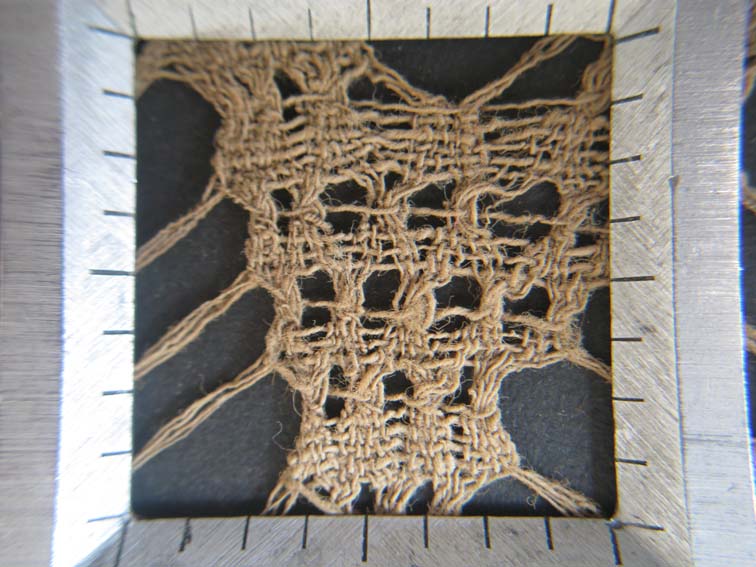
I always finished my studies of a textile by taking several pictures through a magnifying glass. This has helped me now when I am back in Denmark, to keep on studying the different structures in the textile.
This piece is very big. It measures approx. 145 x 64 cm. It is found in Pisquillo, Chico area in the Chancay Valley.

As you can see on this picture it consist of three pieces and is sewn together two times in the warp direction.
The edges in the warp direction is beautiful made. Also the top part of the edges in the weft direction is nicely made, but the down part is scalopped as you can see here.The material is cotton.

Eventhough the pattern is squared, I think the horisontal and vertical stribes and lines stands out because of the floating threads in the weft direction.


This textile had a lot of holes which somebody (perhaps people at Amano or others) have tried to correct.

Here you can see the cotton thread is overtwisted as the threads curls when they lies and floats.

Many of the Chancay Gauzes is overtwisted and I think it gives the apperance of the textile a more beautiful and sofisticated look.
Detail throught the magnifying glass.
The textiles at Amano were categorized into different kinds of patterns. This one belongs to the animal part with the silhouette of a cat face.

It measures approx. 77 x 74 cm.
It was the first textile I chose with a clearly and outstanding embroidery.


I see this fragment as very special as the textile is a Gauze with embroidery on the top. Many of the other embroidered pieces consist of a net with the embroidery part on the top.
Here you can see the part where the textile is sewn together. In this piece it is done in a very beautiful way where the pattern still fits together afterwards.
The embroidered part of the eyes and the mouth of the cat.

Also this piece is in overtwisted cotton.
Detail of the embroidered part. This has been made by a thick thread which prejudice on every single warp thread, but just about every other weft thread. By this there is made a knot or swirl on the other side of the textile.

Now I am going out and buying a big bouquet of sunflowers to my husband, so he can wake up to a special morning of ouer day, to some sun instead of the snow falling down outside.

11.11.10

CHECKPOINT ON CHAIRS.

Yesterday I went to Molskroen, a beautiful and special Inn on the nose of Jutland, Denmark.

Here some of my Checkpoint fabric by the danish textile company Kvadrat, have been put on there very beautiful and old baroq chair.
A before picture.
And after.
I think the chairs looks much more modern and elegant with the Checkpoint fabric.
Checkpoint is made out of 100% Trevira CS, a flameretardent polyester.
Detail.

25.10.10

COLORS FROM PERU.

Today I want to show you some of the beautifull colors of Peru.
In the area of Barranco in Lima I saw this amazing door. Here in Scandinavia we would never put these kinds of colors together, and in a way I think it's sad. They are so beautiful, strong and warm.
Barranco is a very nice area with a lot of creative people.
Peru is famous for all it's different kinds of corns. Here some are a little bit dried and some fresh. The very dark one taste so good and they make a juice called "chinca". I still remember this special taste and is looking forward to drink it again next year when going back on a holiday with my husband.
Different kinds of dried spices, mushrooms, fruit ect. These I saw at a market in Cusco.
All of them had different kinds of purposes to treat illness. Me and my husband bought some of the mushrooms and spices, which we have used in tea.
A beautiful woman sitting at the market in Pisac near Cusco. All the colors is unfortunately synthetic as they are so strong. In natural dyes this is not possible.

19.9.10

STRUCTURES AND TEXTURES IN WEAVING.

Today I just want to show some different kinds of structures and textures in some woven samples I have made many years ago.
The first one was made in 1998 when I was an exchange student at Philadelphia College of Textiles & Science.
It is made on a jacquard loom from Dornier, where I worked with the twill effect. I like the way the twill change from the warp into the weft and how the movement comes into the textile because of this.
These next two samples is woven in the pique technique. The material is silk. On the back of the first textile there is a fine little thread which is elastic. After I took it of the loom I put it into hot water. The threads relaxed and the structure becomes more alive.
The second pique is woven with a filling weft on the back of the textiles. Because of this is becomes more bulky and get much more structure on the surface of the textile.
This last textile is very simple. I have called it; Pearls on a String. Because of the changement in the weft yarn, from thick to thin makes it special.
This textile gave me an internship in Italy at a weaving company; Lanificio Bartolini Sestilio in Prato, as it were very Chanel and Celine like.

28.8.10

ORGATEC.

In the autum of 2008 my textile collection from Kvadrat was beeing presented to the public at the Orgatec fair in Cologne.
The collection is called: the Karina Nielsen Rios´Collection. It consist of Checkpoint -upholstery, Zeze & Yoyo-curtains, Toto -acoustic. All is woven in Trevira CS and coated polyurethane.
Kvadrat is famous for very colourfull designs. In my collection I chose to weave in non-colours. The collection is about the structure of the yarn and the construction of the weave. I was so happy when Kvadrat chose to put my designs into production. For me this is one of the best things that has happend in my textile life. This and receiving the 3-year grant from the Danish State Art Foundation in 2007.
The Kvadrat stand from the outside, designed by Gunilla Allard.
The Kvadrat stand from the outside with some of the black-grey-white shades of my collection.
Kvadrat also had another stand at another place in Cologne. Here they have put up a more simple look with boxes. Again many of the black-grey-white shades is the collection made by me.
The variety in the Checkpoint collection.
Toto, the textile for acoustic.
It was a big honor when I found out that Moroso had chosen to put my whole collection into there own textile collection.
Here are two chairs with two different kinds of Checkpoint structures.